




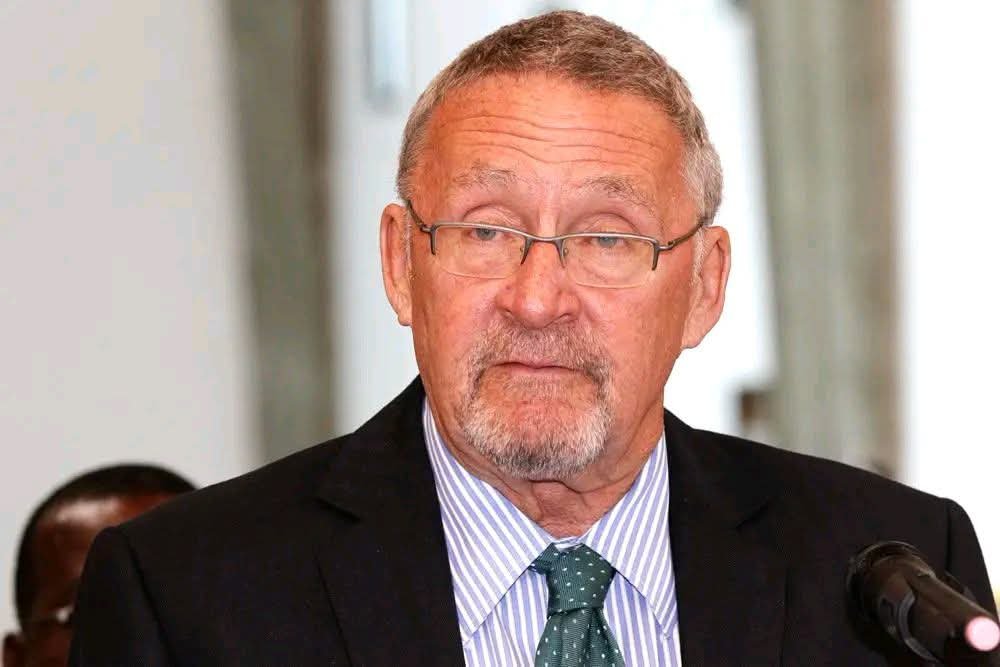
Dr Guy Lindsay Scott (1944–2026)
By Diego Casilli
ZAMBIA has lost one of the sharpest, most unusual minds ever to sit at the heart of its government. Dr Guy Scott — farmer, economist, cognitive scientist, agriculture minister, vice president, and, for 90 turbulent days, acting president of the Republic — has died. He was 82.
He was, by any honest measure, a brilliant man, and an unclassifiable one. Zambian by birth to Scottish and English parents who had made their lives in what was then Northern Rhodesia, he belonged to the country in a way its constitution would later, cruelly, refuse to fully recognise. He read economics at Cambridge, farmed strawberries and irrigated wheat on his own estate in the 1970s, then went back to England in his 30s to study the mind itself — cognitive science, artificial intelligence, robotics — before returning home to spend the rest of his life in the far messier business of governing people. Few Zambian politicians arrived in politics carrying that range of training, and fewer still wore it as lightly as he did.
He made his name first not in the vice presidency that would define his public image, but in a maize field during a famine. As agriculture minister under Frederick Chiluba in the early 1990s, Scott inherited a country with no maize reserves during the worst regional drought in a century. He organised emergency shipments of yellow maize from the United States (US) by ship and rail, and by most honest accounts kept the country from starvation. Zambians called him “Mr Yellow Maize.” He was proud enough of the achievement, and disgusted enough by his abrupt dismissal in 1993, that he reportedly framed the sacking letter and hung it in his farmhouse guest toilet — a small, characteristic act of a man who took the work seriously and the politics around it a good deal less so.
He was, above all, a listener and an arguer in the best sense — a man who held a mild, unfashionable socialism and never treated it as settled doctrine, always willing to hear a better argument and change his mind if one arrived. That openness, paired with real intellectual force, made him a formidable ally and an equally formidable adversary. It is likely no accident that his closest and most consequential political partnership — with Michael Sata, in building the Patriotic Front (PF) from 2001 onward — was between two men who by all accounts argued constantly and trusted each other anyway.
Parkinson’s disease found him early in his political career and never let go. It is one of the cruelest ironies of his life that a mind so restless and so quick was housed, for its most consequential years, in a body working steadily against it. He managed it as best any person could — which is to say imperfectly, in public, without much complaint — and kept working. Those who dealt with him in those years describe not a man diminished, but a man taxed, doing the job anyway.
That job became, briefly and unexpectedly, the presidency itself. When Sata died in a London hospital in October 2014, Scott — as vice president — became acting head of state, the first person of European descent to lead a mainland sub-Saharan African nation under full democratic rule since F.W. de Klerk. He could not stand for the office in his own right; Zambia’s constitution required both parents of a presidential candidate to be Zambian by birth or descent, a clause written years earlier for entirely different reasons and applied to him anyway.
He spent his 90 days holding a grieving, fracturing party together — dismissing and then reinstating a secretary-general within 24 hours, facing down cabinet colleagues who wanted him gone, refusing to go. Those 90 days did not just fill a vacancy; they reset the terms of Zambian politics for a decade after.
He wrote it all down eventually, in Adventures in Zambian Politics: A Story in Black and White — a memoir readers have described as unusually funny and unusually honest for the genre, more interested in Zambia’s story than his own, generous almost to a fault toward Sata and modest to a fault about himself. It is the record, in his own irreverent voice, of a man who spent 60 years arguing that Zambia could be governed better, and who kept trying to prove it long after most people would have stopped.
He was taken by circumstance before his time — a mind that never stopped working, in a body that, for too many years, would not fully let it. Zambia is smaller for his absence, and better for the 60 years he gave it.
Rest in peace, Dr Guy Scott.