



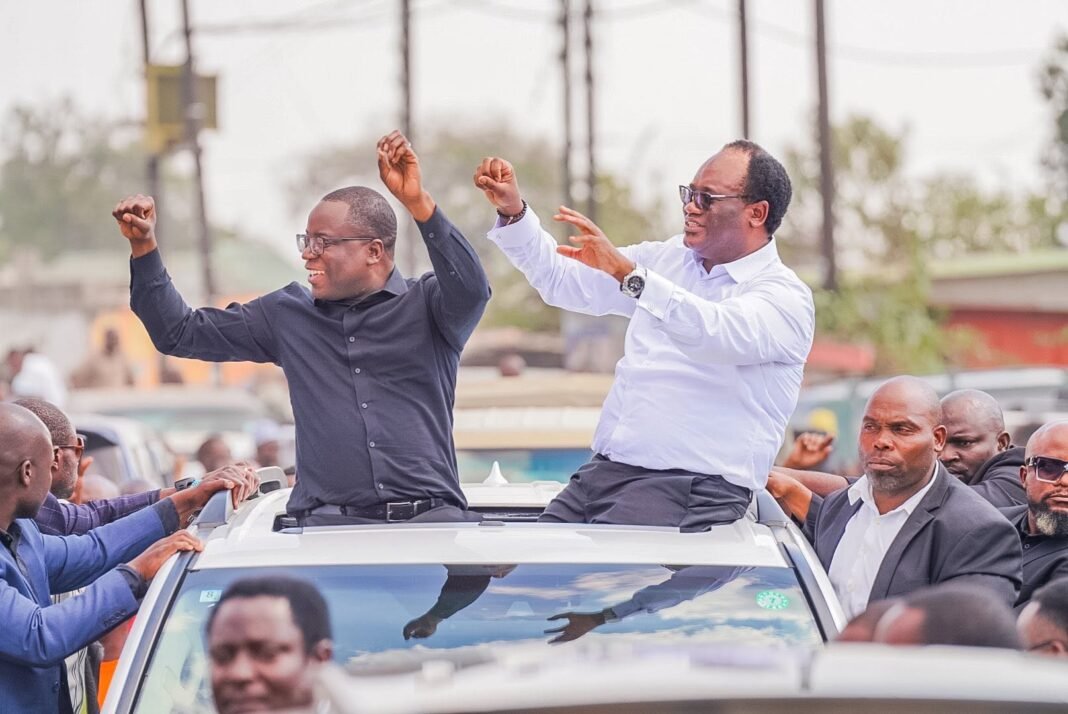
Hichilema is fighting Lungu in Mundubile and Makebi
Everything Lungu did to Hichilema is now being done to Mundubile and Makebi, only this time, more aggressively than before.
By Kanyanta Chanda Kapwepwe
ZAMBIA is neither dealing with a cow nor the king of the jungle. The nation is dealing with a severely wounded buffalo. And a wounded buffalo does not simply retreat. It remembers. It charges. It fights anything that looks like the enemy that wounded it.
That is what makes the unfolding political drama surrounding Brian Mundubile and Makebi Zulu so disturbing. Hakainde Hichilema appears to be governing through many of the same coercive practices that once made him an international symbol of opposition persecution. But there is a more troubling twist in that Hichilema has repeated what was once done to him and gone even further.
The similarities have become impossible to ignore. The ballot tally. The police attacks and obstruction of opposition activities. The storming of the opposition leaders’ homes. The blocking of access to the courts. The treason charge. Mukobeko Maximum Correctional Facility. Restrictions surrounding access to the accused. All this unfolding in the immediate aftermath of a fiercely disputed presidential election.
It is a real and deeply troubling political pattern with potentially damaging consequences for Zambia’s constitutional democracy. Many of the methods that Hichilema loudly condemned when Edgar Lungu’s government used them against him have now resurfaced under Hichilema’s own presidency against Mundubile and Makebi. Yet in several of the most consequential episodes, the 2026 version appears to have gone further, pushing Zambia closer to constitutional lines that should never be crossed.
The irony is difficult to escape. The man who once cried persecution now presides over a State accused of persecuting his principal political opponents in almost the same manner. The opposition leader who was once tear-gassed, blocked, arrested, charged with treason and sent to Mukobeko is now President, while another opposition leader walks an eerily familiar road toward the same prison.
Is it coincidence or political necessity? It is clearly a case of vicarious revenge, pushing Zambia into a disturbing cycle in which yesterday’s victim has inherited the machinery of his former perceived persecutors and turned it against today’s opposition.
To understand just how extraordinary the similarities have become, we need to rewind the clock and place the experiences of Hakainde Hichilema under Edgar Lungu alongside what Brian Mundubile and Makebi Zulu are experiencing under Hichilema.
The optics become far clearer when some of the many events are placed side by side rather than viewed as isolated incidents.
- Restricting the opposition candidate’s campaign movements.Under Lungu, police repeatedly interfered with Hichilema’s ability to move around the country. In July 2021, authorities prevented him from departing Kenneth Kaunda International Airport even after flight clearance had reportedly been obtained. Days later, police detained him at Chipata Airport, blocked the road from the airport and fired tear gas at supporters. Then Hichilema complained that the opposition campaign space had been restricted and that police were harassing opposition parties.
The Mundubile parallel is most uncanny. In March 2026, Mundubile was intercepted at Kenneth Kaunda International Airport, prevented from leaving and taken to Ibex Police Station. This time, however, the intervention ended not merely with a travel obstruction but with a formal criminal charge under the cybercrime legislation. Later in June 2026, armed police surrounded the lodge where Mundubile and Makebi Zulu were staying in Ndola and reportedly ordered them to leave the Copperbelt because Hichilema was expected in the province.
This is particularly revealing because the police interpreted the president’s presence in a province so broadly that previously scheduled opposition events were cancelled merely because Lungu would be visiting the same province. Eight years later, Mundubile was told that his presence in an entire province was impermissible because Hichilema was arriving. That is less a new method than a resurrection of an old unfair political tactic.
- Police obstruction and attacks on rallies.Hichilema unquestionably experienced serious campaign repression under Lungu. This included the cancellation of UPND rallies in Chawama and Kanyama in 2016 and a reported incident in which a UPND supporter was shot dead during protests following the cancellations. Hichilema complained that the Public Order Act had been exploited to favour the PF and restrict the UPND campaign.
Mundubile’s 2026 campaign encountered the same machinery. Armed police sealed Mpezeni Park in Chipata and prevented his scheduled rally from proceeding. In July, police fired tear gas into his Kalingalinga roadshow, with reports that a minor was injured during the incident. Later, police stopped another convoy in Kabwata.
One may argue that Hichilema’s 2016 experience involved a fatal incident, while Mundubile’s 2026 experience resulted only in an injury. In any event, neither incident should occur in a peaceful, democratic space.
- The 2026 election itself is more troubling.Hichilema alleged that the 2016 presidential election had been rigged. He criticised the lack of a level playing field, weaknesses in tabulation and the failure to provide an adequate legal remedy. But critically, independent observers also noted that parallel vote tabulation broadly affirmed the official 2016 presidential result. They similarly identified weaknesses in results management and transparency without concluding that the
- Presidential count had been fraudulently reversed. The 2026 position was materially worse. It revealed something important that did not exist to the same degree in 2016 or in the history of Zambia. At approximately midday on 14 August 2026, the Electoral Commission of Zambia (ECZ) suddenly suspended the counting and announcement of results throughout Zambia for over six hours. ECZ said polling officials had been attacked and that in some places marked ballot papers had been stolen from ballot boxes. However, the Commission did not provide a comprehensive list showing precisely which stations were affected or why isolated incidents required a nationwide suspension.
This is the point at which the election changed character. Suddenly, during the six-hour suspension, there was a heavy armed military presence at totalling centres, while an armed group reportedly stormed the centres and took almost all the polling-station result forms.
After counting resumed, a statistically designed verification exercise by independent observers found the official presidential shares significantly inconsistent with the expected range. Independent observers consequently described the election as involving allegations of tally manipulation and serious irregularities, while other observers believed Hichilema probably would have won regardless.
- The presidential petition: the most extraordinary.In 2016 Hichilema actually succeeded in filing his election petition. His problem came afterwards. The Constitutional Court ultimately dismissed it because the constitutionally prescribed 14-day hearing period had expired. The substantive allegations were never fully tried. The court itself was divided: the majority regarded the deadline as binding while the minority considered the petitioners entitled to be heard. Observers later described the failure to provide Hichilema with an effective remedy as a serious democratic setback.
What happened in 2026 went one step further institutionally. On 24 August, the final filing day, Zambia’s superior courts were physically closed and access blocked. The Constitutional Court and other top courts were inaccessible, while a Judiciary memorandum said staff should not report for work for security reasons. Human Rights Watch concluded that the closure effectively obstructed access to justice precisely when presidential challenges had to be filed.
That was a significant escalation. In 2016, the opposition entered the courthouse, lodged its case and was defeated through the court’s interpretation of procedure. In 2026, the physical avenue to the registry itself was shut on the critical day.
The political optics are even more devastating. On 25 August, Secretary to the Cabinet Patrick Kangwa announced that no presidential petition had been filed and that Hichilema’s inauguration would proceed, relying on a communication from Judiciary Chief Administrator Nalishebo Imataa that no petition had been recorded at the Constitutional Court Registry by 18:00 on 24 August.
However, a presidential petition was eventually sent to Chief Justice Mumba Malila’s private email on 24 August by former Law Association of Zambia (LAZ) president Linda Kasonde. The Chief Justice acknowledged receipt and described that method as highly irregular but referred the documents to the Constitutional Court to determine whether they constituted a valid filing. A separate petition involving Brebner Changala and the LCK Freedom Foundation was also reported as having been lodged. Therefore, it was inaccurate for the Judiciary Chief Administrator and the Secretary to the Cabinet to say absolutely that “no petition exists.”
- The storming of the opposition leader’s home.In April 2017, more than 100 armed police reportedly surrounded Hichilema’s residence. Police cut the electricity supply, damaged the perimeter, entered without a search warrant, and used tear gas against Hichilema and his family inside the property. Hichilema later described the operation as an ordeal lasting many hours, and the Catholic bishops characterised the force used as massive and disproportionate.
The corresponding raid on Mundubile’s Kabulonga residence after the 2026 election crossed a line that the 2017 raid did not: someone died. Former minister and opposition figure Mutotwe Kafwaya was fatally shot during the security operation, and the body was taken to an unknown place. Mundubile and his family were taken out of the house and dumped in the middle of nowhere. The others were arrested and taken into police custody.
- The 2026 crackdown widened far beyond Hichilema’s 2017 prosecution. Hichilema and five others faced treason proceedings. Mundubile and Makebi are now part of a treason case involving 18 accused persons, including senior political figures, lawyers, a bishop and businessmen. The government said the allegations involve unlawful paramilitary activity, sponsorship, aiding and abetting, and threats to national security.
That is another clear escalation in scale. The 2017 case targeted the opposition leader and several associates following the presidential-motorcade confrontation. The 2026 proceedings appear to place a much wider section of the opposition leader’s political and professional network inside an alleged insurrectionary conspiracy.
- Mukobeko: A quick maximum-security incarceration.After Hichilema was charged with treason, he was initially held in police custody and at correctional facilities in Lusaka before being transferred to Mukobeko roughly two months later. International observers issued an urgent action in June 2017 alleging degrading and potentially inhuman conditions there. Mundubile, Makebi and Findlay, by contrast, were flown to Mukobeko under armed guard almost immediately after the treason charge was formalised.
That was a stark contrast. Hichilema eventually ended up at maximum security after judicial proceedings had already been under way. Mundubile and Makebi were rapidly airlifted there at the beginning of their prosecution. Through the first week of September 2026, lawyers were still complaining about the absence of a scheduled court appearance, while the Human Rights Commission (HRC) was publicly urging prompt disposal of detention cases. Government, however, says the cases are before competent courts and that due process will be available.
- Access to the detained leaders denied.Hichilema’s lawyers and party repeatedly alleged that they were initially denied access to him in 2017; police denied that allegation. His lawyer eventually obtained a court order confirming access to lawyers and family. At Mukobeko, some senior UPND officials and traditional leaders were prevented from visiting him, but his wife was allowed in and could bring him food. Correctional authorities publicly said he could receive three visitors at prescribed times.
Mundubile’s lawyers said nobody was permitted access for part of the period immediately following transfer, after which family and lawyers were allowed limited access. However, it later emerged that the legal team had again encountered difficulty reaching them and that the prison had refused Mundubile and Makebi’s request to receive food from outside. There were also allegations that army commandos rather than ordinary correctional officers were guarding them.
- The post-election sequence is more compressed and militarised in 2026.In the earlier cycle, Hichilema disputed the 2016 election, filed his petition, lost the opportunity to have its merits heard, continued opposing Lungu, and was arrested for treason seven months later following the Kuomboka confrontation. In 2026, Mundubile disputed the election; his residence was raided almost immediately; Kafwaya was killed; leading associates were arrested while votes were still being counted; Mundubile and Makebi sought UN protection; the superior courts were shut on the filing deadline; they were handed over to police; they were charged with treason; and they were rapidly transferred to Mukobeko. What took months to escalate against Hichilema after 2016 has unfolded against Mundubile in roughly two weeks surrounding the 2026 election.
That sequence raises serious concerns about Zambia’s democratic trajectory. After comparing the two periods, one may therefore conclude that Hichilema is taking vicarious revenge. The sequence provides enough evidence to argue that the political machinery once used against Hichilema has been reproduced under his own presidency, becoming more aggressive and more dangerous.