






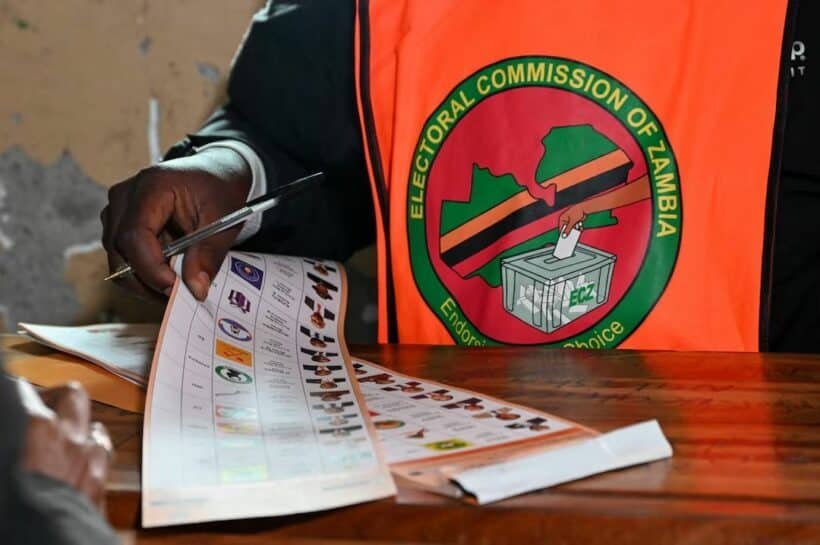
Zambia voted: Did the election deliver the people’s will?
By
Professor Cephas Lumina
The Electoral Commission of Zambia (ECZ) has announced a winner in the presidential election. However, the unexplained halt in counting, deteriorating tabulation standards, military involvement, and unresolved statistical anomalies raise a bigger question: did the country’s 2026 election truly meet the Constitution’s promise of a free, fair, and transparent expression of the people’s will?
A DEMOCRATIC election is more than just picking a winner. It is how people give legal authority to their government, as set out in the country’s Constitution. Article 1 says the Constitution is supreme. Article 4 defines Zambia as a multi-party democracy, and Article 5 states that power belongs to the people. Articles 8 and 9 make democracy, good governance, and integrity key national values.
President Hakainde Hichilema has been declared re-elected with about 60% of the presidential vote against roughly 38% for Brian Mundubile. But a declaration does not end the constitutional inquiry. The harder question is whether the electoral process, considered as a whole, provides a sufficiently reliable basis for saying that the outcome genuinely reflects the will of the Zambian people.
This question is highlighted by two key articles published on 18 August 2026: one by Nic Cheeseman and Nicole Beardsworth in The Africa Report (“‘Amateur’ Hour: Zambia’s election was flawed and may need to be rerun”), and another by Washington Katema in the Mail & Guardian (“How Zambia lost the plot: Inside a troubled election”). Neither claims another candidate won, but both point out issues that a serious democracy cannot ignore.
“Free and fair” means the whole election
Article 45 is the constitutional centre of gravity. It requires that citizens be free to exercise their political rights; that universal adult suffrage rest on equality of the vote; that elections be free and fair and free from violence, intimidation, and corruption; and that electoral administration be independent, accountable, efficient, and transparent. It also requires a simple and practical system of voting and tabulation and timely resolution of electoral disputes.
“Free and fair” is a broad standard. It is not just about people voting peacefully. It covers everything from voter and candidate registration, nominations, campaigning, and political finance to media access, freedom from intimidation, polling, counting, announcing results, handling complaints, and providing judicial remedies. Article 50 ensures media access for parties and candidates, while Articles 103, 73 and 159 provide remedies for presidential, parliamentary, and local government electoral disputes.
Polling was mostly peaceful. Cheeseman and Beardsworth note that SADC observers found a calm atmosphere at 99% of polling stations. However, the real test of an election’s quality covers the entire process, and the biggest concerns came after voting ended.
The ECZ suspension demands a better explanation
On 14 August, ECZ Chairperson Mwangala Zaloumis announced an extraordinary nationwide interruption:
“In view of the security situation and continued threats of violence, the Commission has with immediate effect suspended the counting and announcement of results throughout the country in accordance with Section 67(3) of the Electoral Process Act No. 35 of 2016.”
The European Union Election Observation Mission Election Observation Update, dated 19 August 2026, now puts that decision in sharper focus. It records that the nationwide suspension lasted from 12:00 to 18:00 on 14 August, and that ECZ cited violent incidents targeting polling staff and allegations of ballot-box theft. Crucially, the EU observers state that “No further details were provided on the locations and how systematic or isolated these incidents were.”
That absence of specificity matters.
Section 67 does allow counting procedures to be suspended with Commission approval. But the statutory scheme is deliberately polling station based. Votes must be counted where they were cast; counting should commence immediately after closure and continue until completion; and, where it is suspended, the presiding officer must secure the electoral materials. Section 68 then requires the polling station result to be announced and published.
Section 75 is even more instructive. Where ballot papers at a polling station are lost, destroyed, or unlawfully removed before counting and announcement, the law provides for a revote at that polling station. And election law expressly enables presiding officers to direct police officers to maintain order at polling stations.
The real issue is not whether the ECZ could authorize a suspension, but whether a nationwide suspension was needed and appropriate, given that the Commission did not share details about where or how serious the incidents were.
Article 45 of the Constitution requires accountability, efficiency, and transparency. A constitutionally defensible response should have identified the affected polling stations, suspended proceedings there where necessary, secured the ballots, documented the chain of custody, and allowed unaffected counts to proceed.
The Zambia Conference of Catholic Bishops made precisely the institutional point that needed making in its Pastoral Statement on the Conduct and Climate of the 2026 General Election, issued on 16 August 2026. The bishops wrote: “An election is only as credible as the transparency of its counting and tallying process.” They called upon the ECZ to act transparently and concluded with a sentence that should now be pinned to the wall of the results centre: “The Commission owes the nation clarity, not silence.”
The EU update makes the tabulation problem more serious
The EU’s 19 August update matters because it shifts the focus beyond just the six-hour suspension.
EU observers were present for tabulation in sixty-four totalling centres. Before the suspension, they assessed tabulation as “very good” in 43% of their observations. After counting resumed, they say the “overall conduct of tabulation deteriorated significantly.” Transparency was rated “bad” or “very bad” in 12% of centres observed and “very good” in only 27%.
The details are troubling. After the suspension, staff failed in a higher proportion of observations to record results on tally sheets as soon as they were announced: 42%, compared with 30% before the suspension. The proportion of observations in which figures entered into the digital results-management system corresponded with tally sheets fell from 100% before the suspension to 81% afterwards. Observers also reported extended breaks in almost half their observations, with returning officers appearing to wait for instructions from ECZ headquarters before announcing results.
None of this proves the results were faked. But it does make it harder to trust the tabulation process without question.
The EU update records further disruptions: an armed group attacked the Makeni totalling centre in Lusaka on 15 August and took almost all polling-station result forms; credible witnesses told observers that alleged UPND cadres raided two of three totalling centres in Kabwe on 16 August, fundamentally disrupting tabulation. Those incidents deserve investigation regardless of the political identity of the alleged perpetrators.
Just as consequentially, the EU says the ECZ did not publish partial results on the results website it had launched and confirmed that it would not publish disaggregated polling station results. The Mission has therefore repeated its call for “maximal transparency” and publication of results broken down by polling station.
This is not just for show. Publishing results by polling station lets parties, observers, journalists, and citizens check the national outcome for themselves.
Why was the military inside an electoral process?
Nothing should trouble a constitutional democracy more than the sight of soldiers moving into the machinery that converts ballots into governmental power.
An election is a civilian constitutional exercise. Ballot custody, tabulation, observation, and the declaration of results are not military functions. Yet the 2026 election saw the Defence Force become conspicuously visible around polling and tallying centres precisely when confidence in the results process was most fragile. AP documented soldiers and armoured vehicles around Lusaka, including at the main results centre.
The EU’s 19 August update makes the issue more than one of bad optics. Its observers report that, after the suspension, a “heavy military presence in totalling centres” was reportedly intimidating to most interlocutors and that the number of party agents and citizen observers present was lower than before.
Every Zambian, no matter their party, should be concerned about this.
Article 190 requires the Defence Force and national security services to be non-partisan and forbids them from furthering the cause of a particular organisation or acting against a constitutionally permitted political interest. Article 192 defines the Defence Force’s constitutional functions principally in terms of defending sovereignty and territorial integrity and cooperating with State institutions in public emergencies and national disasters. Article 193 assigns the Zambia Police Service the ordinary responsibility for preserving peace and maintaining law and order.
No responsible analysis should assert, without evidence, that soldiers altered results or seized ballots. But neither should Zambia normalise the militarisation of an election count. Where soldiers are present inside or around totalling centres and accredited observers report intimidation and reduced participation by agents and citizen monitors, the burden falls on the authorities to explain the legal basis, scope, and limits of that deployment.
The ZCCB put the concern forcefully. It questioned “the deployment of army officers to police functions in connection with this election” and warned that visible military personnel at polling and tallying centres risked intimidating “voters, poll agents and officials.” On custody it was categorical: “Ballot papers are not the property of the security services; they are the property of the Zambian people.”
That is the correct approach under the Constitution. Security forces can protect elections, but they should never seem to take part in running them.
When opposition arrests shadow the ballot
The broader political environment cannot be severed from the result. Amnesty International records that opposition leader and former presidential candidate Xavier Chungu was arrested on 28 May 2026 after a podcast interview and later charged under the State Security Act, with sedition and under the Zambia Security Intelligence Services Act. He was denied bail on 10 July. Amnesty characterised his detention as arbitrary and called for his release.
On 14 August, authorities reportedly arrested eleven people, including senior opposition members, during a raid at a private residence where Mundubile was present. The government claimed shots were fired and said those arrested had military-grade weapons and materials for an uprising. Mundubile denied these claims and called the raid an attack on his life. These serious allegations need a proper criminal investigation, evidence disclosure, and due process, not political judgment without proof.
The numbers demand an explanation
Cheeseman and Beardsworth identify at least twenty-seven constituencies in which the UPND received a presidential supermajority and turnout exceeded 80%, against a national registered-voter-weighted turnout of 57%. These high-turnout constituencies were concentrated in UPND strongholds.
In sixteen constituencies examined more closely, they identify a difference of more than 170,000 votes between presidential and parliamentary participation; in Solwezi North, the turnout gap exceeded forty-six percentage points.
They are appropriately cautious. These figures do not establish who caused any irregularity, how it occurred or that Mundubile would otherwise have won. Their own unverified estimate places the suspicious presidential-parliamentary turnout difference at between 350,000 and 550,000 votes, below the roughly 1.1-million-vote margin separating the principal candidates.
An anomaly does not prove fraud. But it is a reason to investigate, especially when there are also problems like disrupted counting, worse tabulation standards, fewer observers, and no publication of polling station results.
The country needs proof, not reassurance
Article 229 of the Constitution entrusts the ECZ with implementing the electoral process and conducting elections. Article 216 requires constitutional commissions, including the ECZ, to be independent, non-partisan and impartial. The Electoral Commission of Zambia Act No. 25 of 2016 requires the Commission to supervise elections fairly and impartially and to ensure that they are free and fair.
Independence does not mean freedom from scrutiny. It means freedom from improper control combined with an obligation to demonstrate fidelity to law.
The obvious confidence-building measure is now a full documentary reconciliation: publish the disaggregated polling station results, the relevant Gen-20 forms, constituency tallies, records of corrections, incident reports, and the chain-of-custody documentation for affected electoral materials. That is broadly the logic of the forensic audit urged in the 18 August Mail & Guardian analysis.
If the records reconcile, transparency will strengthen Hichilema’s mandate. If material discrepancies or constitutional violations are established, Article 103 provides a judicial remedy and empowers the Constitutional Court to validate or nullify the presidential election.
Article 5 says sovereignty belongs to the people. Article 45 prescribes the conditions under which votes translate that sovereignty into lawful authority. Article 229 entrusts the ECZ with that translation.
The question is therefore not whether critics can prove from suspicion alone that Hichilema lost. They cannot. The constitutional question is whether the ECZ can demonstrate from the electoral record that the declared winner won through a process that was genuinely free, equal, transparent, and accountable.
Given the ECZ’s unexplained suspension, the EU’s reports of worse tabulation, the military’s involvement, and unresolved statistical issues, Zambians have the right to ask for proof—not just reassurance—that the election result truly reflects their will.