






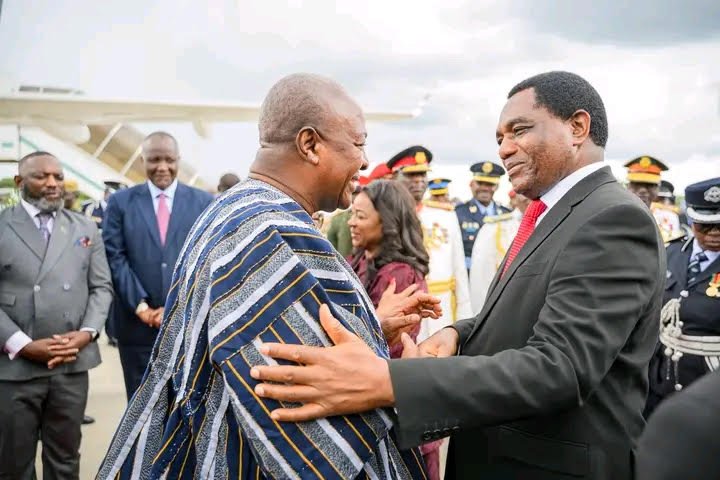
Forget the Fugu: Visa-free Zambia and Ghana is the real story

RATHER than focusing on the Fugu, traditional garment famous among men from Northern Ghana, I am told the country should have paid heed to a bigger story that Zambia and Ghana will introduce a visa-free regime between the two countries.
This means when a Zambian wants to travel to the West African country, there will be no need to apply for a visa, and the other way round.
But the Fugu seems to have generated more interest in social media debates when many Zambians noticed that Ghanaian President John Mahama donned it during his visit here recently and appeared in the garment even during official functions.
Otherwise, the more important story is the one on the visa waiver between the two countries. This is a positive development, especially that Africa is advocating more on integration to boost trade, tourism and in retrospect developing economies of the continent.
At the moment, there are not very many countries in Africa that have waived visa requirements, or those that allow Zambians to obtain a visas on arrival.
These include South Africa, Tanzania, Namibia, Rwanda, Mauritius, Mozambique and Seychelles.
But last year, Zambia and Namibia agreed that the two countries would move even a step further and scrap the use of passports and opt to use national identity cards. Once that is implemented, Zambians wishing to travel to Namibia would only require a National Registration Card (NRC) to cross into that country.
On the other hand, Namibians would shelve passports and simply wave a national identity card when coming to Zambia.
Namibia’s Minister of Home Affairs, Immigration, Safety and Security, Albert Kawana revealed this during the country’s 59th independence anniversary celebrations in the capital, Windhoek
According to the minister, the two countries were in the final stages to work out modalities before implementation.
Landlocked Zambia needs similar facilities, with other countries, like the Namibian deal to boost trade that benefits both countries and above all contributing to enhancing economic activities across the board. Namibia and Botswana seem to have already tied the knot over the facility.
Africa needs to move faster to speed up integration. The rest of the continent should emulate Zambia and Namibia, scrap passports and allow citizens to use national identity cards.
This will cut red tape and other impediments that contribute to delays in the flow of goods and services. Though regional integration initiatives such as through the Southern African Development Community (SADC), Common Market for Eastern and Southern Africa (COMESA) and the just established African Continental Free Trade Area (AfCTA), are available, it will be more beneficial if individual countries adopt local initiatives to break up barriers.
When you look at places like Europe and other continents, it is easier to travel within regions there compared to Africa. Why should it be so?
In any case, historically there were no trade barriers in Africa. Communities practiced barter system. That means if Zambia grew maize and the Democratic Republic of the Congo (DRC) grew beans, the two nations simply exchanged the commodities not withstanding borders because they were not existing.
It was colonialism that fostered barriers in Africa leading to the countries stifling trade between each other.
When barriers are broken between countries, sectors like tourism will be heaved high. Crop sales between countries will encourage people in individual nations to grow more food because the market would be available.
Boosting agriculture and tourism alone would lead to increased employment opportunities on the continent.
That is why I thought the announcement that Zambia and Ghana would waive visa requirements should have been a more exciting piece of information than worrying about a Fugu won by the Ghanaian President
Zambians should be happy that once that is implemented, it will be easier for entrepreneurs to travel to Ghana and bring home the Fugu for resale here, which by implication is already popular.
What however, is more imperative is for more African countries to tear down barriers either scrap visa requirements or go the Zambia, Namibia route to forgo passports and let citizens use national identity cards. This development will not only promote economic prosperity but would bring the people of the continent even closer in other sectors.
Africa must follow the European Union example instead of clinging to old colonial legacies which we have come to learn have only been pulling the continent back.
Hicks Sikazwe is author of Zambia’s Fall-back Presidents, Wasted Years, and Voters in Shadows. A former deputy Editor-in-Chief of the Times of Zambia, he is currently a Communication and Media Affairs advocate based in Ndola. Comments 0955/0966929611 or hpsikazwe @ gmail.com.