





El Niño: Are we ready?
THERE is a word travelling faster than the rains it threatens to withhold. On timelines, in market queues, in parliamentary corridors and around office water coolers from Lusaka to London, “El Niño” has become the season’s most anxious utterance. It is not idle chatter, on 3rd September 2026, the World Meteorological Organisation (WMO) issued one of the starkest advisories in its history, declaring that El Niño is “firmly established” and will intensify into a “very strong” event before the year is out, one that United States (US) forecasters now give a 69 percent chance of exceeding every El Niño recorded since 1950.
UN Secretary-General António Guterres put it bluntly: El Niño, he said, “is being supersised before our eyes,” and the planet is sailing into “uncharted waters”. WMO Secretary-General Celeste Saulo added a sentence with the weight of five decades behind it: “Never before in the 50-year history of the WMO have we launched such a major mobilisation.”
For Zambia, a nation whose lights, harvests and household budgets are tethered to the rains, that is not a distant meteorological curiosity. It is a question addressed directly to us: are we ready?
Understanding the beast
El Niño is not a storm, nor a single weather event, rather, it is a shift in the planet’s ocean-atmosphere machinery. Under normal conditions, easterly trade winds push warm Pacific surface water westward toward Asia, allowing cold, nutrient-rich water to rise off South America.
However, El Niño occurs when those trade winds weaken or reverse, letting the warm water slosh back eastward and pushing sea-surface temperatures in the central and eastern Pacific well above average. This disrupts what is known as the “Walker Circulation,” which is the great east-west loop of rising and sinking air that ordinarily brings rain to Indonesia and Australia and dry air to South America, during El Niño, that pattern flips, dragging rainfall away from its usual home.
According to the Australian Bureau of Meteorology. It is a natural cycle, recurring every two to seven years and typically lasting nine to eighteen months, and the WMO is emphatic that it is not caused by climate change, though it is now unfolding atop an already-warmed planet, which amplifies its bite.
Its signature, tracked through the Niño 3.4 index, has climbed alarmingly: from +1.5°C above normal in mid-2026 to weekly readings between +2.2°C and +2.6°C by August, with subsurface Pacific waters over 8°C above average in places, numbers that UK Met Office scientist Adam Scaife says he has “never seen” in forecasting history.
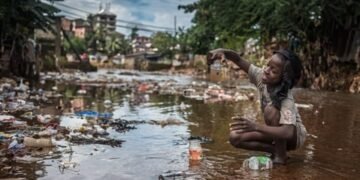
The consequences are strikingly asymmetric: drought typically settles over Australia, Indonesia, southern Africa and parts of the Amazon, even as South America’s Pacific coast and East Africa brace for floods, and India’s life-sustaining monsoon weakens. History has already written the tragedy in three unforgettable chapters. The 1982–83 event brought biblical flooding to Ecuador and Peru while igniting catastrophic fires in Indonesia, and was entangled with famines that claimed hundreds of thousands of lives in the Horn of Africa.
The 1997–98 “Super El Niño”, which is still the historical benchmark, killed more than 20,000 people, inflicted roughly $36 billion in damage, bleached 16 percent of the world’s coral reefs, and fueled a Rift Valley fever outbreak that may have infected 89,000 people in East Africa.
Then came 2015–16, when southern Africa suffered its worst drought in three decades, Indonesian peat fires shrouded 43 million people in toxic haze, and the food security of up to 100 million people worldwide was thrown into jeopardy.
Economists Christopher Callahan and Justin Mankin, writing in Science, calculated that the 1997–98 event alone cost the global economy $5.7 trillion over the following five years, citing a “persistent” drag on growth lasting up to 14 years, borne disproportionately by the world’s poorest tropical nations. The Peterson Institute now estimates the current event could cost the global economy up to $17.6 trillion over six years, and, tellingly, names Zambia among the ten most exposed economies on earth.
Zambia’s bitter familiarity
Zambia does not need a forecast to know what El Niño feels like, we have lived through it, repeatedly. In 2015–16, dwindling rains forced ZESCO to ration power to households and industry alike. By 2018–19, the driest season since 1981 struck the Southern Plateau, threatening the 70 percent of Zambians whose livelihoods depend on farming. But nothing prepared the nation for 2023–24, when President Hakainde Hichilema stood before the country on 29 February 2024 and declared the drought a national disaster, describing devastation across 84 of Zambia’s 116 districts.
Nearly a million hectares of planted crops, almost half the national total were lost. The Kariba Dam, which anchors roughly a third of the nation’s power generating capacity, edged within 77 centimetres of a total shutdown. Load-shedding, which began at eight hours a day, spiraled to 21 hours, by September 2024, Bloomberg reported some households receiving barely three hours of electricity daily.
The kwacha became, for a spell, the world’s worst-performing currency; inflation climbed to a three-year high of 16.5 percent; the IMF slashed its growth forecast from 2.3 to 1.2 percent. Glencore’s Mopani mines threatened to lay off close to 38,000 workers as power shortages crippled Zambia’s copper lifeline, which supplies roughly 70 percent of the country’s foreign exchange earnings.
Behind the statistics stood human suffering of a different order: according to independent estimates, 5.8 million people needed humanitarian assistance, UNICEF warned that 52,000 children faced malnutrition, and in Western Province, 65 percent of children were reduced to a single meal a day.
That history now feels less like memory than premonition. Southern Africa’s regional climate forum, SARCOF-33, gathered in Swakopmund in August 2026 and warned that a strong El Niño, potentially “the strongest event in living memory”, is set to govern the 2026/27 rainy season, with below-normal rainfall estimated across southern and central Zambia from October.
FEWS NET confirms the trend, projecting delayed rains, a shrinking planted area and eroding household purchasing power through the season, with the south and southwest hardest hit. The country enjoyed a merciful, La Niña-tilted reprieve in 2025/26, but the respite may prove brief.
A nation preparing, unevenly
To its credit, Zambia has not stood idle. In a landmark reform, the Disaster Management (Amendment) Act, 2026, assented into law on 8 April 2026, renamed the DMMU the “National Disaster Risk Management Division,” deliberately shifting the country’s posture from reactive disaster management toward proactive risk management.
This builds on top of a genuinely respectable foundation, the Disaster Management Act, 2010, the National Disaster Management Policy, the Eighth National Development Plan’s risk-informed development outcome, and Zambia’s National Adaptation Plan and NDC 3.0 submissions to the UNFCCC.
The United Nations Development Programme, reviewing this architecture, in its Policy Brief of October 2024, credits Zambia with an “excellent foundational presence” of laws and institutions running from national to village level. Ahead of this season, the DMMU has prepositioned thousands of tonnes of relief food, and government reports the installation of over 200 automated weather stations and the training of 600 agricultural extension officers. Chastened by 2024, Zambia has also begun a genuine pivot toward solar power, commissioning a 100-megawatt plant and a 312-megawatt distributed programme in 2026.
Yet the same UNDP review, and the IMF’s own 2025 analysis, expose sobering gaps. Zambia has no stand-alone drought policy, leaving stakeholder roles undefined and coordination costly and duplicative. Disaster risk reduction remains barely mainstreamed into the national budget, with environmental spending siting below 0.2 percent of GDP against an estimated $17.2 billion in climate-adaptation needs.
Irrigation covers less than six percent of cultivated land, leaving smallholders, a quarter of the workforce, almost wholly hostage to rainfall. Progress at the national level has not been “replicated at the local level,” per UNDP, and Zambia’s own government admitted to the UN that resource mobilisation for its 2024 drought response was simply “slow.”
No large-scale weather-index insurance or comprehensive social protection scheme yet cushions ordinary households from these recurring shocks, a gap that, left unaddressed, will keep transferring the cost of climate volatility onto the country’s poorest.
The verdict
El Niño will not ask for Zambia’s permission before it arrives. The legal reforms of 2026, the solar plants rising from the plateau, the weather stations dotting the provinces are genuine, hard-won progress, and they deserve recognition. But progress is not the same as readiness, and a nation that has been struck three times in a decade cannot afford to mistake legislative intention for institutional capacity.
The honest answer to the question this article poses is: partially. Zambia has built the skeleton of resilience, a disaster law, a policy architecture, an early-warning network in its infancy. What remains is to put muscle on those bones: mainstreamed budgets, a dedicated drought law, deeper irrigation, real social protection, and the political will to fund anticipatory action before, not after, the rivers run dry and the lights go out.
The world’s meteorologists have given their warning in the clearest language available to science. Whether Zambia heeds it in time will be measured not in the eloquence of its policies, but in the number of meals its children eat this coming season.
The author is a Legal Practitioner and lectures Constitutional and Administrative Law and writes in his personal capacity as a civic education initiative.