




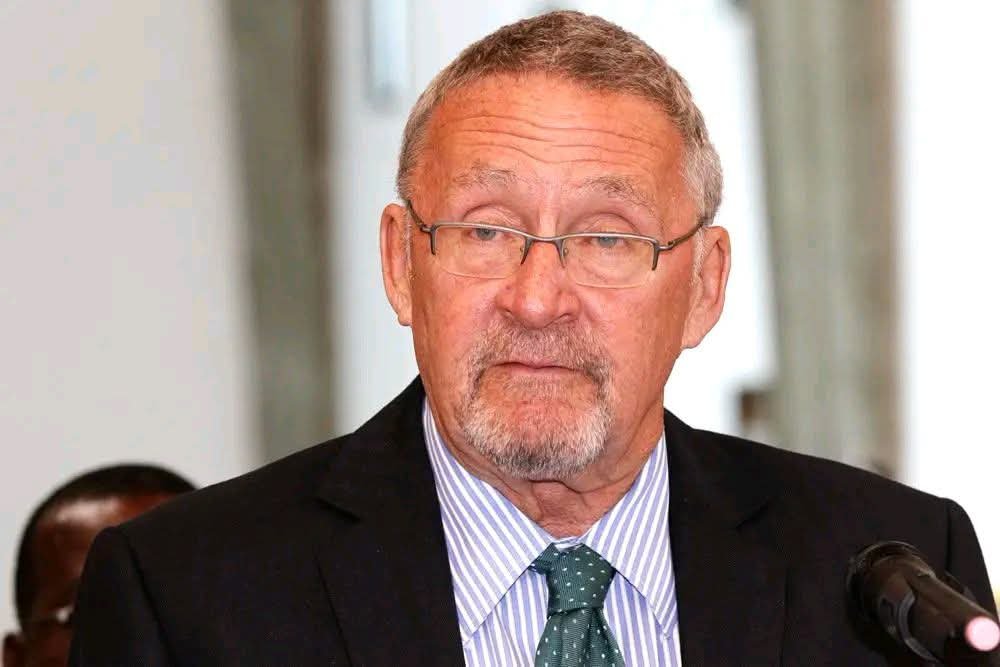
Guy Scott: The white Zambian who earned a place in the nation’s history
… Dr Scott’s unprecedented journey from vice-president to acting President became a defining moment in post-independence Africa
WHEN former Zambia’s vice-president Dr Guy Scott, who died in Lusaka last week, briefly served as the country’s acting President, he made global headlines, attracting widespread international media attention.
Following President Michael Sata’s death in 2014, the Constitution required that, in such an event, the Vice-President step into the shoes of his former boss for three months until a by-election was held.
World newspapers, including those in the Middle East, according to international media reports, went wild with headlines about a white President emerging in an independent African country just 20 years after apartheid had ended in South Africa.
Yet while Dr Scott was Vice-President, he was not allowed to act as Head of State each time President Sata was out of the country. Instead, those who stood in included then Finance Minister Alexander Chikwanda, Cabinet Ministers Edgar Lungu, Wynter Kabimba and, at one time, Emmanuel Chenda.
Even when he was appointed Vice-President, he admits in his book, Adventures in Zambian Politics, that it was not only a surprise but also a shock, which his family found difficult to absorb. The shock did not end there. It also surprised members of the Patriotic Front (PF), who could not believe that President Sata had overlooked senior party members in favour of a white Zambian man who, although born in Zambia, to become his deputy.
Dr Guy Scott was perhaps Sata’s closest ally, having at one time lived in Mpika District, where Sata hailed from. Their friendship and mutual trust grew over the years, solidifying a lifelong bond.
His father, Dr Alexander Scott, emigrated from Glasgow, Scotland, to Northern Rhodesia in 1927 to work as a medical doctor. He later became a journalist, politician and co-founded the African Mail in 1960. The newspaper subsequently evolved into the Central African Mail and, after being acquired by the Zambian Government in 1965, was eventually renamed the Zambia Daily Mail in 1970.
Earlier in 1970, Dr Guy Scott decided to venture into farming, becoming a successful commercial farmer. Scott then left Zambia in 1982 for the United Kingdom (UK) where he studied for a doctorate in Computer Science. He remained there until 1990, when he returned to join the campaign for the restoration of multiparty politics.
Upon his return from the UK, he immediately re-established links with his longtime colleague, Michael Sata. Together, they contributed to the formation of the Movement for Multiparty Democracy (MMD), which dislodged the United National Independence Party (UNIP) in the historic 1991 general elections.
“Disillusioned by the failures and betrayals of Zambia’s one-party state, he nonetheless seized the opportunity in 1990 to support the nascent Movement for Multiparty Democracy (MMD), becoming Minister of Agriculture in the new MMD Government in 1991,” writes Professor Miles Larmer, Professor of African History at the University of Oxford, in the foreword to Scott’s book.
Dr Scott contested and won the Mpika parliamentary seat and was subsequently appointed Minister of Agriculture. According to his book, he was attracted to the MMD after witnessing what he describes as the disastrous effects of state control under Zambia’s first President, Kenneth Kaunda, and UNIP. Throughout his time in the MMD, he remained a strong supporter of the new government’s policies and programmes.
While serving as Minister of Agriculture, he stirred controversy over the culling of pigs from several farms to contain an outbreak of swine fever. It has been suggested that this single incident may have contributed to his removal from Cabinet in 1993.
He remained Member of Parliament for Mpika and maintained close connections with those in government. Later, when Sata broke away from the MMD to form the Patriotic Front (PF), Scott followed him. When the PF formed Government in 2011, Scott emerged as Vice President to his longtime friend.
When Sata died in 2014, Scott assumed the role of Acting President for 90 days until a by-election was held. Former Justice Minister Edgar Lungu, who at the time held several ministerial portfolios, was elected President to complete Sata’s first term.
Born on June 1, 1944,Scott attended school in Southern Rhodesia, now Zimbabwe, before studying at the University of Cambridge and later the University of Sussex, where he read Economics and Computer Science.
Many people who worked with him insist that he was a good human being. He combined forthrightness with a strong sense of humanity, enabling him to relate easily with people in both urban and rural communities.
Perhaps that is why he found such a close friend in Michael Sata, who was equally humorous, although his style of humour sometimes offended many people. With the return of multiparty politics in 1990, Scott never took a back seat but became part of the movement that promoted plural democracy, which continues to this day.
At a personal level, I also knew him. He was reliable, highly informative and broad-minded. When I wrote my first book, Zambia’s Fall-back Presidents, published in 2021, I contacted him seeking permission to reference material from his book. I was surprised when he readily agreed without hesitation. When I told him I had written about him and that some of my conclusions might not please him, he replied, “Do not worry. Like you, I do not believe in censorship.”
Later, I met him at the airport in Johannesburg, South Africa. Seeing me, he called out, “Hey you, why did you delay writing such a book?”
Throughout his political life, Scott dedicated himself to serving the people. It is therefore no surprise that he teamed up with Sata to form the Patriotic Front (PF), whose ideals were centred largely on improving the lives of ordinary Zambians. For that alone, many Zambians will remember him as one of their own.
Hicks Sikazwe is the author of Zambia’s Fall-back Presidents, Wasted Years and Voters in Shadows. A former Deputy Editor-in-Chief of the Times of Zambia, he is currently a Communications and Media Affairs Advocate based in Ndola. Comments: 0955 0966929611 or hpsikazwe@gmail.com