







A plan to save elephants sparked a deadly conflict
Malawi conservation project has left dozens of people and elephants dead, becoming a cautionary tale about the pitfalls that can accompany good intentions
By Nicholas Bariyo
LUMEZI, Zambia—Three-year-old Dickson Ngwira was deep into his afternoon nap when half a dozen elephants, using trunks as trowels, gouged a five-foot-wide hole in the brick wall near his bed.
His mother, Matilda Banda, was caught out in the open. Unable to reach Dickson, she hid in the bushes as the animals wrecked her home and devoured the family’s corn supply.
She pictured her son being trampled to death. It wasn’t hard to imagine; elephants had crushed her cousin the previous year.
Dickson survived the November rampage, concealing himself under a pile of baskets. Since then, he’s suffered from bouts of uncontrolled sobbing and relentless nightmares.
“My child is no longer the same happy little boy,” said Banda, 23.
Here on the border between Zambia and Malawi, elephants are trampling farmers and farmers are shooting elephants in a conservation project gone badly wrong.
Dozens have died. Crops needed to stave off starvation have been decimated. Poaching is resurging. It’s a cautionary tale about the pitfalls that can accompany good intentions.
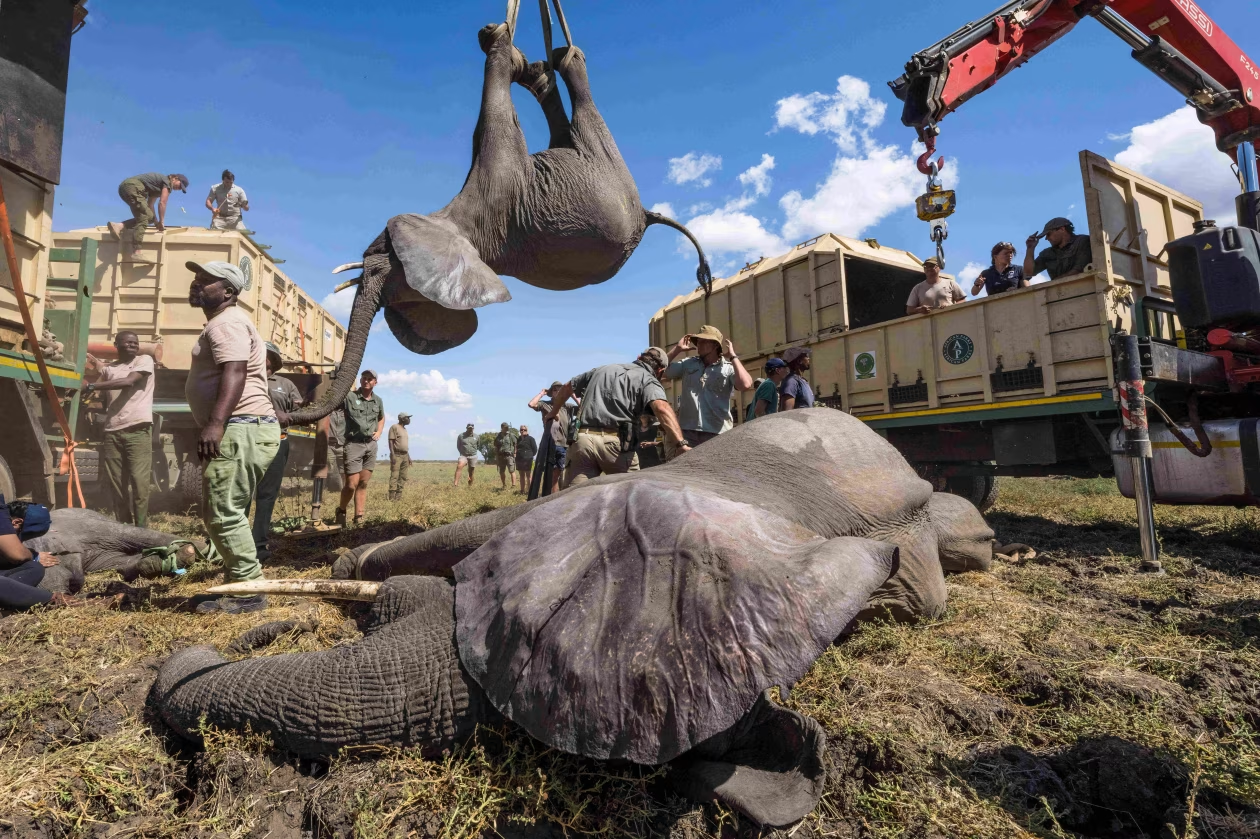
In 2022, a Netherlands-based conservation group, the International Fund for Animal Welfare, helped the government of Malawi truck 263 elephants from Liwonde National Park in the south, which had too many elephants, to Kasungu National Park in central Malawi, which had far fewer. The 280-mile relocation was part of the country’s broader conservation efforts.
For environmentalists, the imperative was clear. Elephant populations have grown in pockets of Africa, such as Kenya and Zimbabwe, due largely to a drop in poaching. But that recovery doesn’t come close to making up for the staggering losses of previous decades. In the 1980s, there were 1.3 million elephants in Africa. Today there are 415,000, according to the International Union for Conservation of Nature.
“The goal was to ease pressure on Liwonde and help rebuild a viable elephant population in Kasungu,” an IFAW spokesman said.
The 2022 effort tripled the elephant population in Kasungu park, boosting Malawi’s tourism industry with it. IFAW used images of elephants being lifted by cranes to raise money for further wildlife-protection projects.
Within 24 hours of release, elephants strayed out of the park, crossed the border into Zambia and trampled two farmers to death. It would soon escalate into one of southern Africa’s deadliest conflicts between people and wildlife in recent decades.
‘A wake-up call’
The toll on the human side over the past three years: 26 villagers dead, scores injured, $4.5 million in crops destroyed and hundreds of homes damaged, according to Warm Heart Initiative, a Zambian nonprofit providing social support and advocating for locals.
On the elephant side, nearly half of those moved to Kasungu may have already been killed, mostly by farmers retaliating for crop damage, according to Warm Heart Initiative. In late 2024, rangers found five elephants that had been shot in Zambia and died after limping back to Malawi.
“Elephants are very smart animals; they do pretty much what they want at any time,” said Adam Hart, a conservation scientist at the University of Gloucestershire in England. “It is very risky to move them around.”
IFAW and Malawian officials fenced off most of the park, but not the section of park boundary along the border between Malawi and Zambia. Malawi’s Department of National Parks and Wildlife said both countries agreed the border should remain unfenced to allow wildlife to cross freely.
“The Kasungu translocations were not well planned,” said Hart, noting that locals weren’t adequately consulted, warned or trained to cope with an increased elephant population. “Their impact will serve as a wake-up call for other organizations planning wildlife relocations.”
IFAW said Malawian wildlife authorities decided to move the herds; the conservationists provided money and technical support. Malawi’s Justice Ministry declined to comment.
With elephant incursions into Zambia growing, farmer Augustine Kumanga organized fellow residents to defend their land. Banging pots and yelling, the 78-year-old retired military pilot routinely led the charge when his neighbors attempted to drive the animals from farmlands.
In one 2023 foray, Kumanga fell, fracturing his arm and ribs as he tried to escape the elephants. It was his third elephant-related injury, and it proved fatal.
Kumanga had worked with a local volunteer group that fights poaching in the national park, according to close associates and family members. “He loved wildlife and conservation, but at the time of his death, he hated elephants,” said his widow, Dorothy Mtonga.
His death brought simmering anti-elephant anger to a boil. Kumanga’s neighbors chased the animals back to Malawi with guns and spears. Some elephants have since been killed in confrontations, according to local conservationists.
Adding to the anger is a prolonged drought in the region that has elephants and humans competing for resources. More than six million people in Malawi and Zambia face hunger after crops failed and cattle starved, according to the United Nations.
A single elephant can eat up to 600 pounds of vegetation and drink more than 50 gallons of water in a day. The newcomers can’t find enough of either in Kasungu, so they raid croplands and villages, according to Benson Zimba, a Zambian conservationist with the local nonprofit Green Nature Zambia.
Elusive solutions
Boniface Nkoma, a 48-year-old farmer on the Malawi side of the border, was biking home from market, carrying a sack of corn, when he crossed paths with four elephants. One animal picked him up with its trunk and tossed him into thick bushes, killing him, according to his widow, Dilisa Chirwa, who witnessed the 2024 attack.
Advertisemen
“He tried to run, but it was too late,” Chirwa said. “The elephants ate the corn after attacking him.”
The sounds of snorts drew Zambian farmer Mkanda Nkhata, 75, out of his house one day in 2024. Arriving at his fruit trees, he found himself face-to-face with a herd of elephants.
One bull charged and knocked him unconscious, before stomping on him. Nkhata’s neighbors rushed him to a hospital with a head injury and broken ribs.
“I have been farming since the 1980s, and elephants had never been a problem for me,” said Nkhata, who is still paying off $100 in medical bills. “All these problems started in 2022.”
Just 50 elephants lived in Kasungu 10 years ago, down from as many as 1,200 in the 1970s, according to conservationists. By mid-2022, the park’s population had rebounded to 120 elephants, which largely stayed in the protected area. The translocation brought the total to 383.
Kate Evans, founder of Botswana-based research-and-education nonprofit Elephants for Africa, said the elephants moved into Kasungu have struggled to adjust.
“The older ones will always try to lead others either to look for new sources of food or go back to where they were translocated from,” Evans said. “With villages so close to the park, this conflict is not surprising.”
IFAW has been working with Malawi’s government to head off clashes between elephants and their neighbors, a spokesman said. Rapid-response teams—made up of locals riding motorcycles and armed with firecrackers and devices that spray chili-pepper irritants—try to steer wandering elephants back into protected areas. A solar fence was installed. An app helps track the elephants.
The IFAW spokesman said clashes occurred even before the new herds arrived. “Human-elephant conflict is unfortunately an inevitability wherever humans and wildlife coexist,” he said.
In May, a pair of leopards invaded a ranch in Botswana, killing two herders and snatching a goat. A few weeks later, crocodiles killed a fisherman along the Zambezi River in Zimbabwe, according to local authorities.
Conservationists, including independent and government agencies, usually try to mitigate tensions by providing jobs, schools, healthcare and other benefits for those living near areas set aside for wildlife. They often compensate villagers when carnivores kill their livestock or herbivores eat their crops. Maasai herders in Kenya and Tanzania are paid around $600 for each cow killed by predators, on the condition that no predators are killed in retaliation, according to conservationists.
The Kasungu translocation has so far eluded such successful solutions.
New risks
A former IFAW employee, Michael Labuschagne, is leading the charge against the project.
Labuschagne, an ex-South African commando, founded Warm Heart Initiative in response to the clashes that followed the translocation. He says when he headed IFAW’s law-enforcement efforts in southern Africa he warned the group that translocated elephants would escape their new home, which didn’t have enough water and vegetation to support the enlarged herds.
“I stressed to IFAW the inherent risk of human-to-elephant conflict in Kasungu, and IFAW failed to adequately address this known risk prior to the translocations,” he said.
He describes the project as a case of “conservation imperialism,” in which poor communities bear the cost of foreign environmentalists’ actions. Labuschagne has also written to U.S. Congress about IFAW, which has offices in Washington, D.C., saying the group should be held responsible for the deaths and crop damage.
Conservationists and government leaders say locals—and wildlife—will ultimately benefit from translocations and other conservation efforts, which have been a boon to Zambian and Malawian tourism industries. Zambia’s tourism revenues shot up 60% in 2024 to $2.5 billion, according to government data. Malawi took in $230 million from tourism in 2024, a 19% jump from a year earlier.
But the resulting anger, according to villagers, has had broader consequences for conservationism in the countries. Many locals no longer report poachers to wildlife authorities; instead, they hunt down and kill stray elephants, according to conservation volunteers.
“Poaching is again cropping up, residents are frustrated,” said Anderson Soko, a Zambian who hunted illegally inside Kasungu in the 1990s but has since joined anti-poaching initiatives.
Victims of attacks, meanwhile, have threatened to sue IFAW, according to British law firm Leigh Day, which is representing potential plaintiffs. Warm Hearts has been documenting evidence for the victims.
IFAW called the legal threat opportunistic and said the victims should seek any compensation from the Malawian government. Malawi’s Justice Ministry declined to comment.
Lawyers are hoping to recruit Matilda Banda, whose son narrowly escaped being crushed during naptime, to join a possible U.K. lawsuit.
Banda said she wants compensation for the losses she suffered. The elephants, after ransacking her house and eating her corn, urinated on what remained of her grain supply.
“I had never been this close to elephants,” she said. “It was a very scary moment.”
Appeared in the January 31, 2026, print edition as ‘Plan to Save Elephants Turns Deadly’.
Nicholas Bariyo is a reporter covering East Africa and the Great Lakes Region for The Wall Street Journal’s Africa bureau.
He is based in Kampala, Uganda, where he writes about politics, economics, conflict and health from the Democratic